Most business owners know that they should try to rank on search engines, but unfortunately, most of them just don’t know how. There is so much information out there, and it can feel like such an overwhelming task. Meta descriptions, tags, connecting to different software platforms… What does it even mean?!
The good news is that there are simple things that you can do as a business owner today to help increase your visibility odds before ever hiring an SEO expert for your site. These simplified SEO points are a great way to get a few wins under your belt.
Here are four things that actually move the needle when it comes to visibility on search engines and AI models:
1. Website Structure
As a web designer myself, I’ve always made it a priority to design websites that are both pretty and functional. That means making sure every site is structured properly, from the headings, to the keywords, to alt tags and to URL slugs.
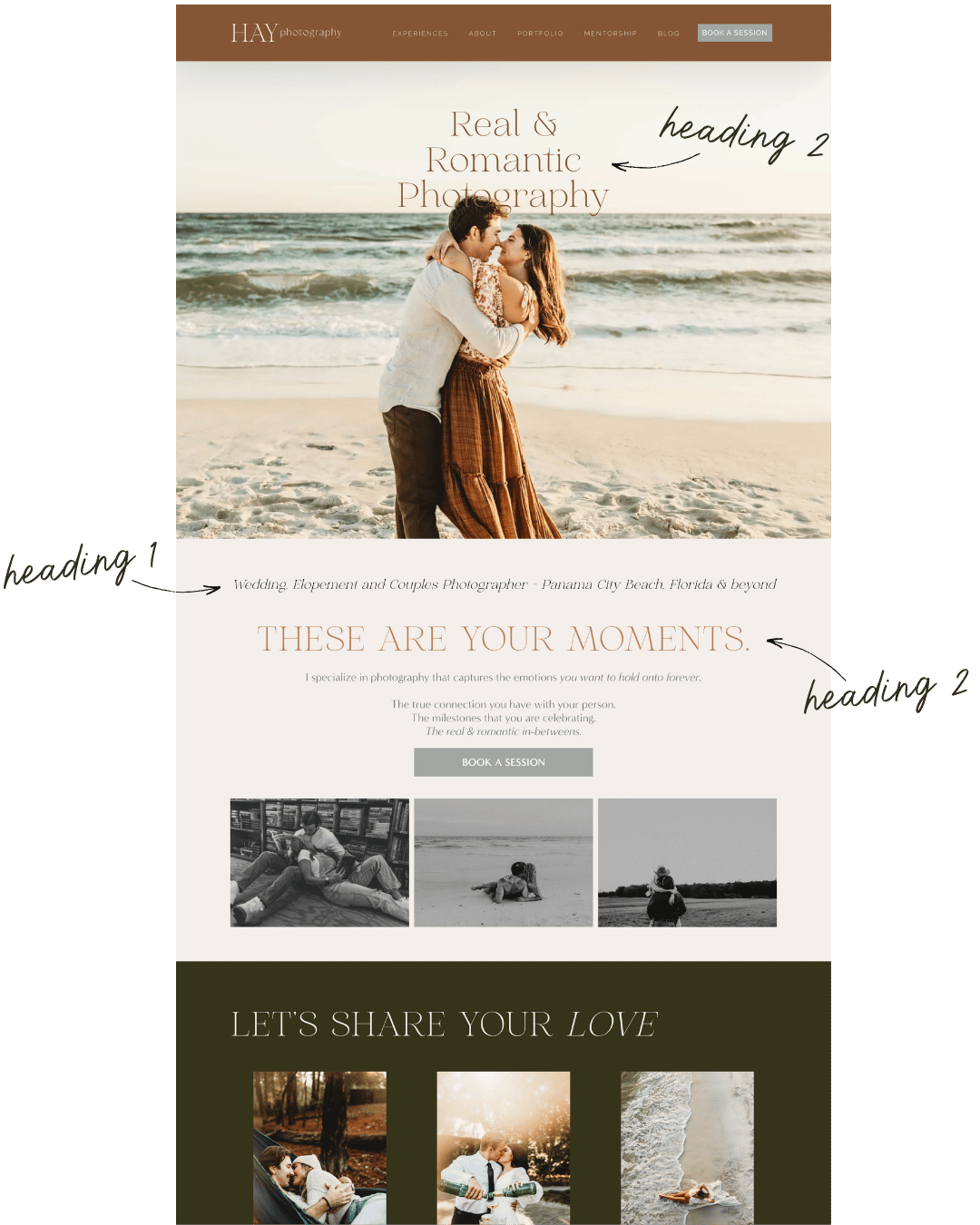
H1 (or Heading 1) is usually the biggest error that I see on DIY sites or those that were done by someone who wasn’t aware of the heading hierarchy. When it comes to best practices, I recommend only having one H1 per page. Multiple of them can confuse website crawlers about which is the main heading, aka the most important sentence. So while you can technically have more than one, it just creates a muddier signal to crawlers. Designers often break this because they're thinking visually with the biggest font and most emotional line instead of structurally. If you want a big, bold, and pretty headline, my recommendation would be to make H2 your larger size font and make H1 slightly smaller so you can tuck it into the page.
Keyword stuffing, which is exactly what it sounds like, will penalize your site. When you add words and phrases that you want search engines to pick up on in a way that looks, feels and sounds unnatural and spammy, it will recognize those patterns and keep your site off the top or the results. For example, if you’re a home organizer, a sentence like this would be considered keyword stuffing: Home organizer helping people organize their home efficiently, so they can have the organized home that they deserve. Stay away from phrases like this, pretty please!
Alt tags are another missed opportunity I see quite often. “Alternative tags” are descriptions that you give images on your site that serve two important purposes: descriptions for screen readers (visually impaired) and image SEO. Keep text around 125 characters or less, and be as descriptive as possible. Trying to avoid keyword stuffing here, too!
URL slugs are the last piece of text that identify a page on your website. For example, this blog post’s slug is /what-google-needs-to-rank-your-site. Your URL slugs should be a concise description of the page and include dashes between words. Search engines read those dashes as spaces, so if you have everything typed together, that’s what it will be read as. Is this a huge factor for SEO? Yes and no. It does help Google classify the information if your heading structure or content isn’t clear. Otherwise, Google claims it’s not super important. (I disagree, but w/e 💁🏼♀️) Better safe than sorry in my book! Do them right regardless.
2. Real trust signals (E-E-A-T)
This is a fast growing piece that search engines and AI models are leaning into – real information, real people, real authority. And that’s exactly why E-E-A-T stands for Experience, Expertise, Authoritativeness, and Trustworthiness.Google and other search engines, including LLMs (like ChatGPT, Grok, Claude, etc), want quality information to share, and when you show E-E-A-T, you’re showing that you are the thought leader on that specific subject.
Here’s what Google is looking for:
Experience – Does the creator have relevant life experience on this topic?
Expertise – Does the creator have relevant knowledge and skills about the subject?
Authoritativeness – Is the creator considered a go-to source in this niche?
Trustworthiness – How reliable, honest and accurate is this content?
The best way to hit all four of these points is to create original, helpful content that is relevant to what it is your site promotes.If you’re a wedding photographer who starts blogging about your favorite crockpot recipes, you’re probably not going to send those trust signals to Google. But if you’re a wedding photographer blogging about the best proposal spots in your town, your favorite wedding venues, and local wedding pros to consider hiring for your day… you’re on the right track!
3. Local visibility and consistency (Google Business Profile + entity clarity)
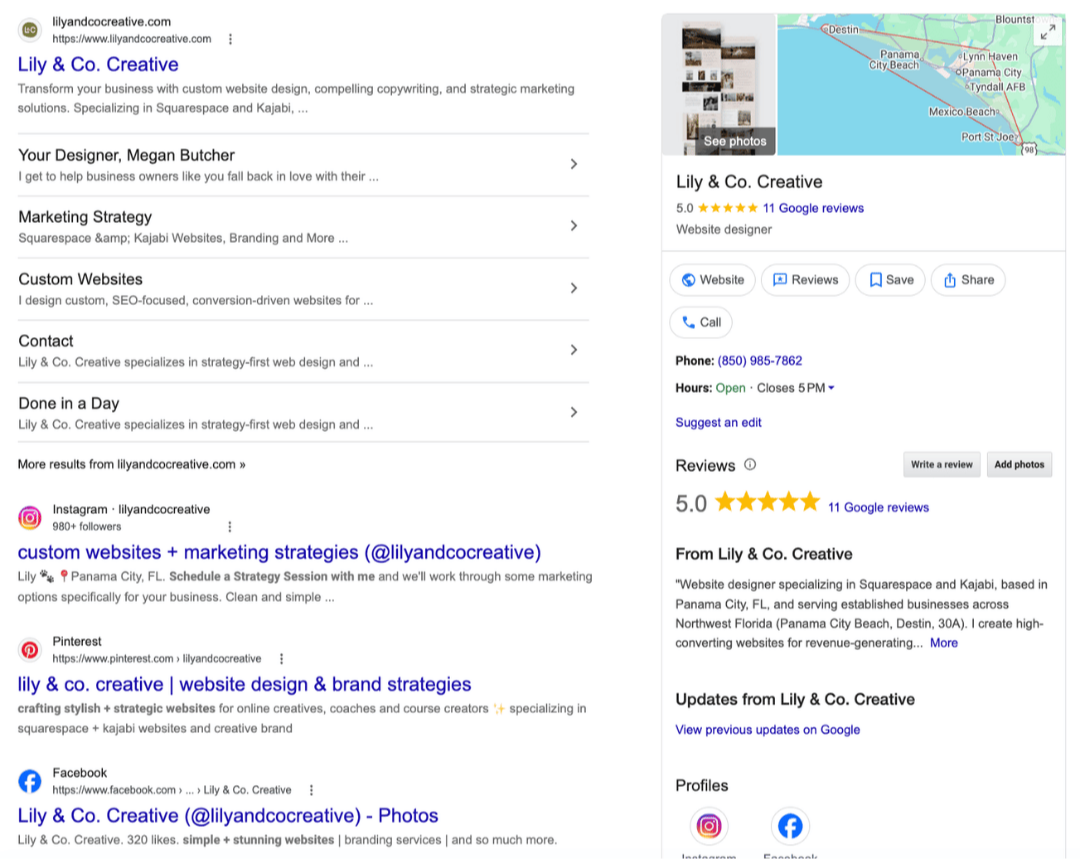
Google Business Profile is something that I think every business owner should have, regardless of whether or not you service your local area. It’s your free, direct listing with Google – the one that shows up with your hours, reviews, photos, and location on Maps and in local search results.
It matters for two reasons: it's often the very first impression someone gets of a business (before they even click to a website), and it's a major local ranking signal, especially for anything with "near me" lingo attached to the query, even if the searcher didn't type those exact words.
Entity clarity is a newer, more AI-relevant half, so if you’re wanting to show up more in AI search results, this is important. Entity clarity (sometimes called NAP consistency: Name, Address, Phone number) is the idea that your business name, address, phone number, and description need to match word for word everywhere they appear online.
Your website, your GBP your Instagram bio, any directory listing. When that's inconsistent (like if my business is listed as "Lily & Co" in one place and "Lily and Co. Creative LLC" in another), it creates confusion for Google and for AI tools trying to confirm who you actually are. Consistency is what lets them confidently say "yes, this is a real, verified business" instead of hedging or skipping you entirely when generating an answer.
Combining them gives concrete clarity. GBP is the concrete action. Entity clarity is the invisible thing that makes GBP (and everything else) actually work. A well-optimized profile with mismatched info everywhere else is like introducing yourself with a different name every time… technically present, but confusing.
4. Patience and Freshness
As amazing as it would be to rank instantly… it does take a little bit of time for all of the good SEO that you’ve got baked into your site to actually show. The real pattern for SEO wins is typically light, early movement that can show up within weeks (a page indexing, a small keyword starting to move), but a consistent, noticeable uptick in traffic and leads typically takes 3-6 months. Real compounding results, the kind that actually change a business, land more in the 6-12 month range.
But how can you keep it moving in the right direction? Google (AI tools even more so) rewards content that is current, not republished with a new date… but actually revisited, updated, and expanded.
Here’s an example: let’s say that you’re an expert in the wellness space, and your blog from 2021 about the best supplements for aging now has outdated information. Go into that same blog, update the information to be relevant, and for good measure, put a disclaimer at the top stating “Updated on DATE: Information regarding XYZ from the original post has been changed to reflect new findings”.
You can always do a check yourself for free by connecting your site to Google Analytics and Google Search Console. While it won’t show you information for all search engines, it will give you a pretty good gauge on what’s working well.

A Client Conversion System made just for you
Solid SEO and a well-designed website can do wonders for your business – and pairing it with marketing and tech to drive that traffic to paying customers is even better. That’s why every website I build combines strategic design, compelling copywriting and smart SEO with built-in tools that help capture leads and drive conversions. If you’re ready for a whole Client Conversion System for your business, click here to schedule a call with me to see if it’s a good fit.